Current student training research projects
At the heart of the four-semester Master's degree course in European Ethnology is a two-semester student training research project. In a joint research process, individual topics are developed and realized in publications, exhibitions, films, websites and the like. Students practice ethnographic and cultural analysis methodology, interpretation, reflection and theory through "learning by doing". In doing so, they acquire important professional qualifications from the development of ideas and projects through to the implementation and public communication of their research. A departmental annual theme takes up the student training research project and supplements it with a public seminar series and other courses.
Transtopias - places of transition. Studies from the perspective of migration
MA study project 2025 under the direction of Johann Verhovsek
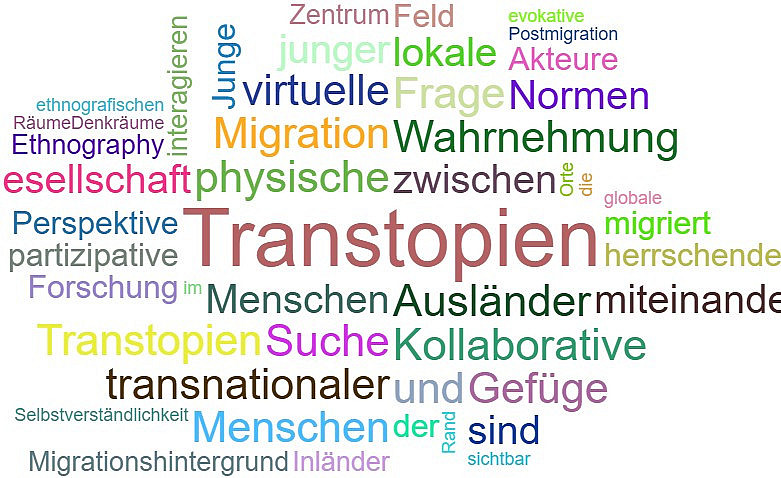
In this Master's study project, we explore "transtopias", i.e. places of transition where the division between nationals and non-nationals is irrelevant, places with a transnational self-evidence where the prevailing norms are questioned. This places the supposed margins of society at the centre. "Transtopias" can be both physical and virtual spaces, as well as spaces of thought or living environments in which multiple local and global actors interact with each other. We go in search of transtopias in the field of young people who have migrated or have a so-called migration background. Perceptual and observational studies, evocative and participatory research methods will be used to visualise transtopian structures. We pursue the post-migrant approach of researching from the perspective of migration. In the accompanying course to this year's Master's project entitled: "Decolonising Ethnography. Collaborative knowledge production in ethnographic research" (Sarah Nimführ), the methodological approaches will be deepened.
Body - Practice - Technics. Critical-ethnographic explorations between craft and industrial production
MA study project 2024 led by Lydia Maria Arantes
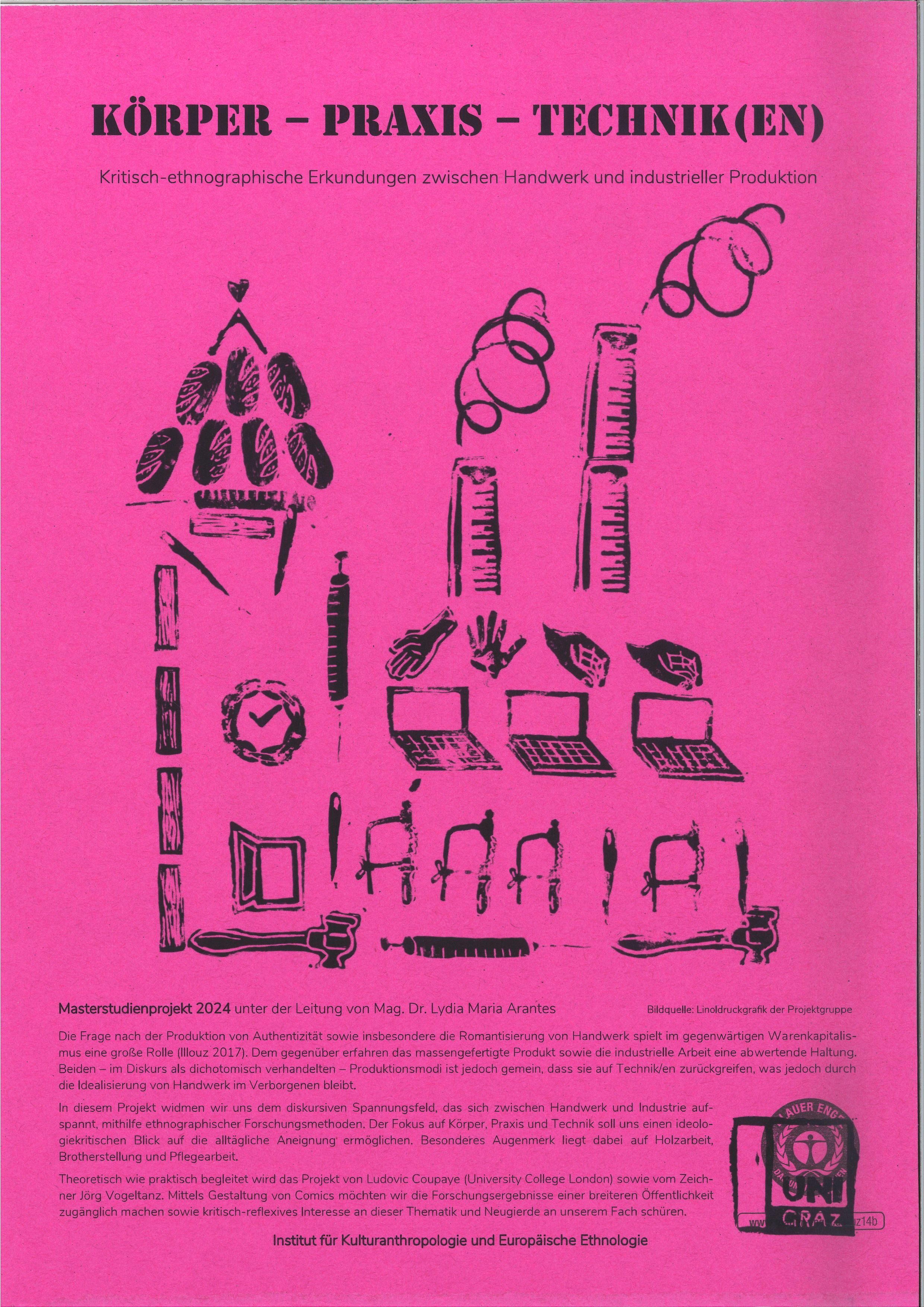
The question of the production of authenticity and, in particular, the romanticization of craftsmanship play a major role in contemporary commodity capitalism (Illouz 2017). In contrast, the mass-produced commodity and industrial work experience a devaluing attitude. Both forms of production, though negotiated as diametrically opposing, draw on techniques and technics, which remains invisible due to the idealization of craft.
In this project, we use ethnographic research methods to explore the discursive tension between craft and industry. The focus on the body, practice and technics (in a broad sense) should enable us to take a critical stance towards the appropriation of everyday (work) life. Particular attention will be paid to woodwork, bread making and care work.
The project will be accompanied both theoretically and practically by Ludovic Coupaye (University College London) and the illustrator Jörg Vogeltanz. By creating comics, we will make the research results accessible to a wider public, as well as stimulate critical and reflective interest in this topic and curiosity towards our discipline.
The Rösselmühle - memory and future of the workers' suburb of Graz
MA student training research project 2023/2024
Led by: Katharina Eisch-Angus, Helmut Groschwitz, Erika Thümmel
From March 2023, students researched the memories, experiences and stories surrounding the impressive building of the Rösselmühle mill in the Gries district of Graz. They spoke to former mill employees and local residents, followed the traces of the mill into the past as well as on the paths of flour and bread, and explored the industrial heritage along the Mühlgang industrial canal in narrative walks and events.
At the same time, they accompanied urban discourses on the preservation and revitalization of the Rösselmühle as a neighbourhood center and meeting place, alongside the process of its destruction.
A lively fabric of work, crafts and industry, of community, cultural diversity and power unfolds around the Rösselmühle.
The result was the exhibition “MEHL GRIES BETON - the Rösselmühle in conversation”. From February 2024 the exhibition has been on tour through public spaces of Graz.
A text brochure was published to accompany the exhibition, which can be requested free of charge at: kulturanthropologie@uni-graz.at
The group continues to campaign for respectful urban development with the public appeal "MEHL GRIES BETON - rettet die Rösselmühle", online at the link provided.

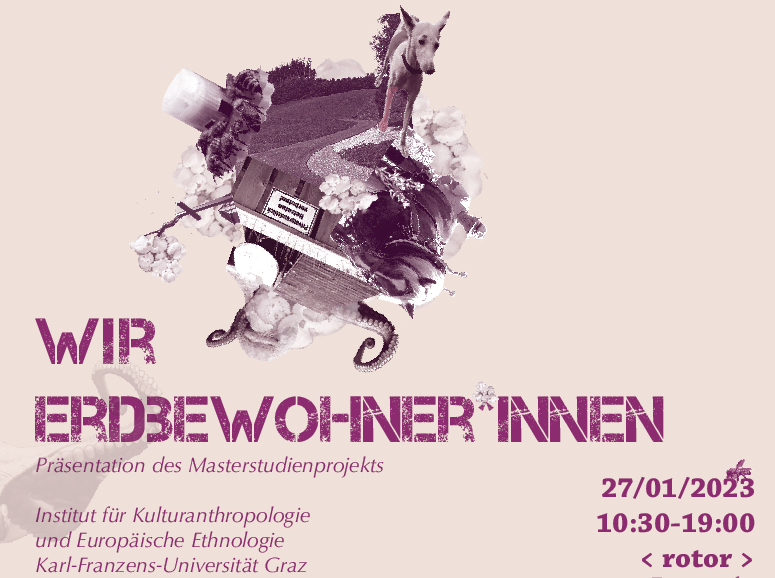
We inhabitants of the earth (human images, solidarity and conflicts in the urban Anthropocene)
MA student training research project 2022/2023
Led by Judith Laister and Maximilian Lakitsch
In cooperation with < rotor > Center for Contemporary Art
Accompanying course: Barbara Grabher and Daniela Brasil
Further information on the study project
As part of the annual theme "ANTHROPOZÄZÄNE GEFÜGE".
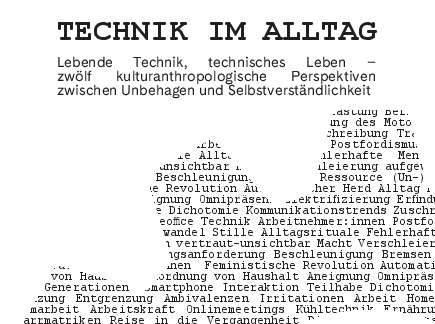
Technology in everyday life
MA student training research project 2021/2022
Led by: Burkhard Pöttler, Johannes Müske (Freiburg) and Marion Hamm (Klagenfurt)
The project was embedded in the annual theme "zero & one: Socio-cultural processes of digitalisation" with lectures by Martina Heßler (Darmstadt), Christiane Berth (Graz), Ina Dietzsch (Marburg), Ruth Eggel (Bonn) and Anne Dippel (Jena).
The project and lecture series were characterised by the Covid-19 pandemic, as not only interviews, but also parts of the course and some lectures were only possible online.
The topics chosen by the project participants range from the development of household technology, the role of the camera in ethnographic film or the change in civil registries to the ambivalences of alarm clocks and smart home technology and the compensation of physical limitations through technical aids. The contributions on online forms of protest, working from home and changes in communication methods through technical aids are particularly characterised by the Covid-19 pandemic.

Work cultures: Critical ethnographic studies and reports
MA student training research project 2020/2021
Led by: Johann Verhovsek, Walther Moser, Leo Kühberger, Klaus Schönberger,
The two-semester project focused on forms of dissolution of boundaries and subjectivation of ways of working and living under post-Fordist, neoliberal conditions. On the basis of ethnographic studies and with a focus on the perspective of the actors, data was to be obtained in various fields of work for an interpretation of current developments. However, due to the outbreak of the corona pandemic combined with comprehensive lockdowns and strict contact restrictions, it was not possible to conduct field research in the summer semester. The number of participants was also very limited. Therefore, the first part of the project focused on an in-depth examination of interdisciplinary research literature on the subject area by Sennett (Der flexible Mensch), Boltanski/Chiapello (Der neue Geist des Kapitalismus), Bourdieu (Prekarität ist überall), Katschnig-Fasch (Das alltägliche Elend), Götz (Arbeitsethnografische Fallstudien) and others. Only a few online interviews were also conducted. This led to the first empirical preliminary studies to develop context-dependent questions.
In summer 2020, a window in the pandemic restrictions opened for a short time. In conversations and interviews with actors and isolated observations of work processes, it was still possible to obtain ethnographic data that was analyzed for its effects on the actors' lifeworlds. From these "ethnographies of proximity" (Götz), critical reports were conceived in the second semester of the project, which, with the support of Walther Moser (a committed radio journalist from Radio Helsinki Graz), could be cast into three very listenable, approx. 30-minute radio broadcasts. The project can be considered very successful in that all three topics covered in the radio broadcasts ultimately resulted in very successful Master's theses.
Laura Bäumel: The "normal everyday life" of mothers. Challenges between gainful employment and housework.Available online: https://cba.media/497806
Marie-Christin Sebl-Litzlbauer: The body as a commodity for sale.Available online: https://cba.media/506839
Carles Garcia-Vive Lopez: Migration - Work - Self-employment.Available online: https://cba.media/497827